
神偷奶爸2India's 75th Anniversary of Independence: How Moscow Became New Delhi's All-Weather Friend_我的网站
一 | Exactly 75 years ago Jawaharlal Nehru, one of the principal leaders of India’s independence movement in the 1930s and 1940s, was sworn in as prime minister of the Dominion of India and raised the national flag at the Red Fort in Delhi. Having brought an end to the colonial rule of the British Empire, the Indian leadership embraced the concept of "non-alignment" and "neutrality" and diversified its ties, seeking new partnerships. At the time, the Soviet Union emerged as a natural ally for the independent Indian state.,Nehru was attracted to Marxism and promoted the idea of evolutionary and inclusive socialism. Back in 1927, the would-be Indian prime minister visited the USSR for the first time together with his wife Kamala, younger sister Krishna, and his father Motilal Nehru, a leader of the Indian National Congress.,The trip was connected with the 10th Anniversary of the Great October Socialist Revolution, which was seen by Nehru and other Indian nationalists in "a very positive light," according to Dr. Anuradha Chenoy, professor of the Center for Russian and Central Asian Studies at Jawaharlal Nehru University.,The Soviet press extensively covered the Nehrus' visit to Moscow, hailing Motilal and Jawaharlal as prominent leaders of India’s freedom movement. Jawaharlal Nehru was received in the Kremlin by Mikhail Kalinin, chairman of the Central Executive Committee of the USSR. Having wrapped up his journey, the Indian politician wrote a booklet titled "Soviet Russia, some random sketches and impressions" (1928).,"Jawaharlal Nehru was influenced by Marxist and socialist thought to some extent, as he saw the need for state intervention for alleviating poverty, developing infrastructure and for development," says Dr. Chenoy. "He thus advocated and made policies to develop state- or public sector industries and also created a Planning Commission. Independent India's Second Plan was especially modeled around the Soviet planning system.",CC BY 2.0 / Public.Resource.Org / Photo 656 Pandit Jawaharlal Nehru at the mike. 20.7.47 Pandit Jawaharlal Nehru at the mike. 20.7.47 CC BY 2.0 / Public.Resource.Org / Photo 656,USSR Helped India Lay the Groundwork for Industrialization,On January 26, 1950, India became a republic within the Commonwealth of Nations with Jawaharlal Nehru serving as the Republic of India's prime minister until May 27, 1964. During this period, the USSR and India started to deepen their ties, according to Dr. Chenoy.,"Soviet support was crucial for an underdeveloped and newly liberated country like India," the academic explains. "Since India wanted to develop as a 'mixed economy,' that is to have both a state and private sector, Western countries refused them any aid and assistance that India needed. So India turned to the Soviet Union. The Soviet Union assisted India in the creation of new steel plants and several infrastructure industries. They assisted in developing Indian science and technology institutions which laid the base for Indian development in later years.",Dr. Chenoy elaborates that in the 1950s, the USSR helped India lay the groundwork for the country's early industrialization, with the Asian giant then starting to receive Russian defense equipment and military hardware.,CC0 / / Indian Prime Minister Indira Gandhi (1917-1984) at the National Press Club, Washington, D.C. 1n 1966 Indian Prime Minister Indira Gandhi (1917-1984) at the National Press Club, Washington, D.C. 1n 1966CC0 / /,Indo-Soviet Treaty of Peace, Friendship and Cooperation,The Indian war with Pakistan in 1971 became a pivotal moment for Indo-Soviet relations, according to the Indian academic. The conflict erupted over the Bangladesh liberation movement in East Pakistan, which was accompanied by killings of the Bengalis – both Muslims and Hindus – by West Pakistani forces led by General Agha Muhammad Yahya Khan in March 1971.,As a result of the violence and instability caused by the onslaught in East Pakistan, an estimated 10 million Bengalis fled to India by May 1971, prompting Delhi to intervene. Judging from documents released in December 2002 by the National Security Archive (NSA), a US non-profit archival institution, US President Richard Nixon and National Security Advisor Henry Kissinger did nothing to curtail the West Pakistani repressions against Bengalis and backed General Yahya.,After India stepped in to shield the Bengalis, "not only did the United States publicly pronounce India as the aggressor in the war, but the US sent the nuclear aircraft carrier, USS Enterprise, to the Bay of Bengal, and authorized the transfer of US military supplies to Pakistan, despite the apparent illegality of doing so," according to the non-profit.,Moscow's help came in handy at the time: in August 1971, India and the USSR concluded the Indo-Soviet Treaty of Peace, Friendship and Cooperation that specified mutual strategic cooperation between the countries. The treaty sent a powerful signal to the US and its allies. Eventually, the conflict ended on December 16, 1971 with the military forces of West Pakistan that were in Bangladesh surrendering.,"The Indian war with Pakistan on the issue of the liberation of Bangladesh in 1971 was a very special moment of Soviet support since the US wanted to help its ally Pakistan," says Dr. Chenoy. "After this, the Treaty of Friendship signed between India and the USSR was very holistic and provided India with much technological and defense support. Since then the friendship has increased.",© Photo : Indian PM OfficeModi Putin MeetModi Putin Meet© Photo : Indian PM Office,India's Strategic Autonomy,The historic Indo-Soviet Treaty of Peace, Friendship and Cooperation was renewed for another 20 years on August 8, 1991. After the collapse of the USSR, Moscow and New Delhi replaced the accords with the 20-year Treaty of Indo-Russian Friendship and Cooperation in January 1993.,Although the dissolution of the USSR resulted in a temporary chill in Russo-Indian economic and trade relations, they were soon reshuffled and are continuing to develop regardless of sanctions imposed by the West, according to Dr. Chenoy.,Since the declaration of independence back in 1947, India has managed to achieve significant strategic autonomy. The country has been maintaining ties with various global powers in accordance with its own strategic plans.,Thus, in June 2022, Indian Foreign Minister Subrahmanyam Jaishankar made it clear at the GlobeSec 2022 Bratislava Forum that India would not copycat the West's anti-Russia policies in the wake of Moscow's special operation to demilitarize and de-Nazify Ukraine. He stressed that “the world cannot be that Euro-centric as it used to be in the past,” adding that India, which is one-fifth of the world’s population and the fifth-largest economy will be guided by its national interests in the first place.。 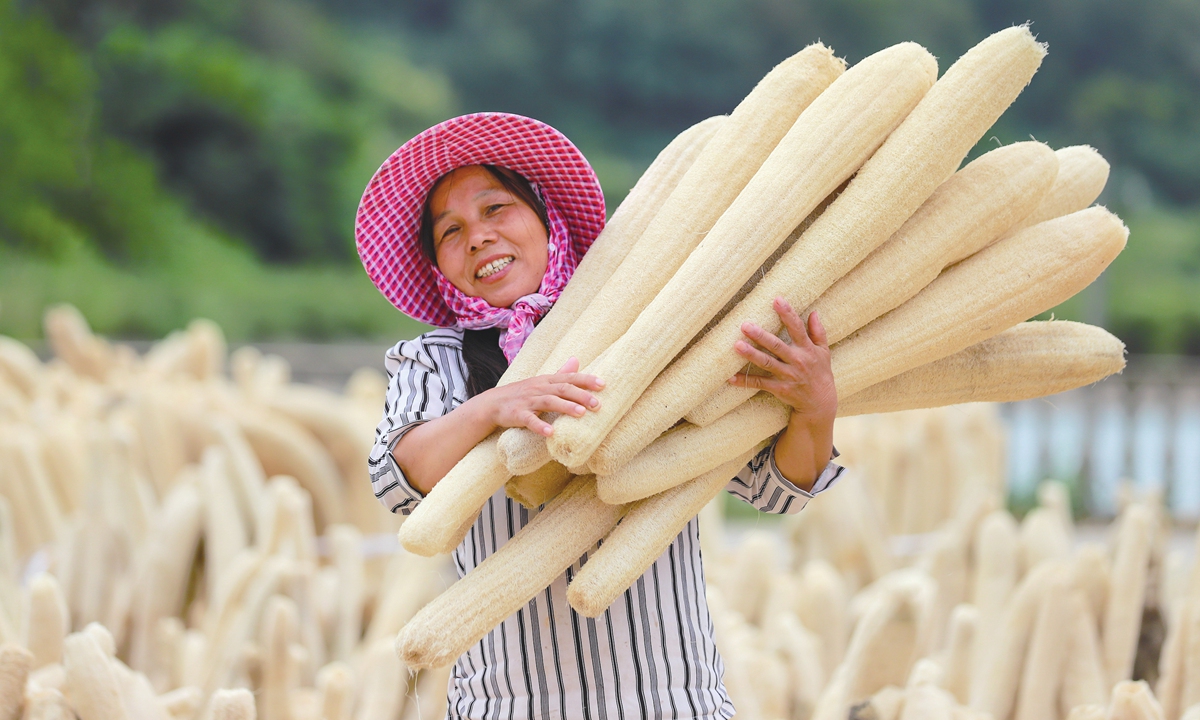 Chinese plush toys, new-energy vehicles and robots often grab global headlines. Beyond the spotlight, however, many unassuming Chinese exports are quietly making great gains in markets around the world. Recently, 14,040 specific pathogen free (SPF) eggs, also known as "diamond eggs" and prized as a critical raw material for vaccine research, took off from Beijing Daxing International Airport and landed in Riyadh, Saudi Arabia. In the first half of 2026 alone, exports of Beijing-produced SPF eggs topped 400,000 units, soaring 254 percent year-on-year. Their export value exceeded 3.8 million yuan ($563,364), up 166 percent year-on-year. Both figures already surpassed the full-year total for 2025, according to statistics from the Beijing customs. "Diamond eggs" are not alone. Many processed farm goods from various regions across China, ranging from loofahs to new corn-based synthetic fibers to "icy persimmons," are reaching consumers in many countries and regions around the world, with rising export volumes. Behind the headline numbers lies a quiet change: China is no longer content to ship out raw apples, live fish, or unprocessed grain. It is climbing the value chain - turning farmyard staples into high-value, shelf-ready products for markets around the world, Zhu Qiucheng, CEO of Ningbo New Oriental Electric Industrial Development, told the Global Times. New e-commerce stars In Shangcheng County, Central China's Henan Province, the loofahs once lived a quiet life next to the stove - serving as kitchen scrubbers. Today they are a cross-border e-commerce star. "We have built processing factories, design teams and unified procurement systems that link agricultural cooperatives and farmers across dozens of villages, turning sponge gourds - a traditional side crop - into a scalable, export-oriented industry," a sales manager at Yuangeng Longshang, a local producer and exporter of sponge gourd-related products, told the Global Times. Processors in Shangcheng have developed more than 60 loofah product lines - ranging from bath sponges and kitchen scrubbers to pet toys and cultural-creative items - and sell them via Amazon, AliExpress, Temu and other platforms to more than 50 countries and regions, according to media reports. In the first half of 2026, Shangcheng's e-commerce transaction volume of loofah-made products exceeded 30 million yuan, up 35 percent year-on-year. At present, the annual comprehensive output value of the loofah industry in the county has exceeded 100 million yuan. Apart from sponge gourds, corn has also found a new way to become cloth. "Unlike traditional synthetic fibers made from petroleum, the core ingredient of our flagship Sorona-based series comes from corn," Hong Boqi, general manager of Chuanyue New Material Co, a domestic cloth supplier, told the Global Times. The process of making Sorona starts by fermenting corn sugars to extract Bio-PDO (a bio-based chemical building block, essentially a plant-derived version of the molecule used in certain plastics). This is then polymerized and spun into yarn and finished fabric. The company has independently developed more than 300 Sorona fabric varieties, said Hong. The firm is also exploring seaweed. Working with a domestic biotech partner, it created an "ice algae mud" functional fabric. Natural seaweed is finely ground and combined with a composite powder made from nephrite, then processed through a specialized spinning method. The finished textile is designed for recycling, reinforcing its green credentials. Behind these advances lie years of patient research and development. Chuanyue invests about 4 million yuan annually in early-stage material development, covering the full journey from lab innovation to finished fabric, said Hong. Innovative ways Apart from being processed into industrial products, Chinese fresh fruits and vegetables are also processed in innovative ways to reach global consumers. For example, Hainan Nicepal Industry Co is not simply selling fresh fruit. Instead, it uses advanced spray-drying technology to turn fresh fruits into fruit powders, concentrated juices, and not-from-concentrate (NFC) purees. Pan Fengying, deputy general manager of the Hainan-based company, said that the company's output value reached 600 million yuan last year, and this year's target is 1.2 to 1.5 billion yuan, according to local media. And in Yi County, North China's Hebei Province, fresh fruit that once spoiled quickly or fetched rock-bottom seasonal prices is now processed into "icy persimmons," which made exports easier. In April 2026, the first batch of 15,000 persimmons was sent to Toronto, Canada. In the first half of this year, the sales volume of the ice-ripened persimmons in the county increased eightfold compared to the previous year; the annual production is expected to be 20 times that of last year, local authorities said. Through controlled processes of de-astringency, sugaring and rapid freezing, the fruit develops a creamy, ice-cream-like texture while retaining its natural sweetness. Local authorities built a shared industrial park complete with standardized workshops, fully automatic production lines and large-scale intelligent cold storage, allowing micro- and small-sized firms to "move in without having to prepare for everything." The China Agricultural Sector Development Report 2026, released in June, projected a pivot toward higher-value agricultural exports from 2026 to 2030. Categories such as processed fruits and nuts, frozen fruits, fish fillets and frozen vegetables are flagged for strong growth potential. The message is clear: volume still matters, but value and differentiation matter more. How did the "sudden" upgrade of the agricultural sector happen? Analysts pointed to two major reasons: pursuit of high-quality development and resilient supply chains. China has emphasized high-quality development, guiding enterprises to focus more on quality over quantity. This has led to deep processing, brand building and new quality productive forces in the agriculture sector, said Zhu. Zhu also noted that the speed and completeness of China's resilient supply chains are powering the transformation. Every link - from raw materials to finished goods, including processing, packaging, and logistics - is tightly connected. 。 Current article:http://8gb.zhaoliebengkuaiwaigeqi.bond/news/20260826_347841.html Published on:06:37:11 |
