
人龙传说
Finding joy in later life_我的网站

A |

B |

Wu's unexpected debut was made possible by a short drama experience program launched by Hengdian World Studios, one of China's largest film and television production bases, in Jinhua, East China's Zhejiang Province. Designed for ordinary visitors rather than professional actors, the program allows tourists to put on costumes, choose scripts, step in front of cameras and receive a professionally edited short video as a "souvenir."
For several hundred yuan, participants complete the entire process - from styling and filming to post-production - and walk away with a one- or two-minute clip in which they become the protagonist of their own story.
According to representatives of the program, a version of the hit TV drama Zhenhuan Zhuan, or Empresses in the Palace, featuring a group of middle-aged and elderly women went viral and garnered more than 1 million views less than 15 minutes after the video was released in September 2022, drawing widespread attention to the trend of ordinary people trying their hand at acting. Today, such experiences have expanded to more visitors, with senior tourists becoming one of the program's key participants.
"This is not an isolated phenomenon limited to one film base," Zhang Yi, CEO of market research firm iiMedia, told the Global Times. He said the trend has grown amid a downturn in the film and television industry, where the shift of production bases across China from "serving only professional crews" to "serving ordinary people" has converged with the rise of new silver economy consumption trends.
At the same time, the trend provides a new direction in the development of the silver economy: Elderly consumers are increasingly seeking experiences that provide enjoyment, self-expression and social connection, Zhang said.
From outsiders to insiders
Hengdian microfilm project director Zhang Jinquan told the Global Times that during this year's summer season, his team has received dozens of visitors every day, with the number sometimes reaching more than 100 during peak periods. Elderly visitors make up a large proportion of participants.
"We hope people can experience the fun of film and television," Zhang said, adding that the team provides a full range of services, including costume design, script selection and acting guidance.
For Wu's daughter, however, her mother's decision to "go shoot a movie" initially came as a surprise.
Many of her old friends who sang and hung out with her had gradually lost touch for various reasons. When I came home from work, I could see she often felt lonely."
Wu is among a growing number of older people who are stepping into studios and transforming themselves from audiences into performers. For many retirees, the experience is not simply about making a video; it is a chance to rediscover confidence, creativity and social interaction.
According to Zhang Jinquan, elderly participants often choose historical costume scripts, with many showing unexpected talent after receiving professional coaching.
"When we opened these projects to the public, we believed that the film industry itself was changing," Zhang Jinquan said.
"With the rise of micro dramas and AI-generated short dramas, filmmaking is no longer something distant and unreachable. Ordinary people can also participate and experience it."
"When choosing experiential activities such as short drama shoots and traditional-style photo sessions, middle-aged and elderly tourists tend to place greater emphasis on cultural depth, a sense of ceremony, nostalgia and quality experiences. They are particularly drawn to the value of fulfilling long-held dreams, creating meaningful memories and sharing their experiences with others," another representative from the studios told the Global Times.
The popularity of these programs also reflects a broader change in elderly consumption patterns. Zhang Yi said that traditional senior consumption was once largely centered around tourism, healthcare products and daily necessities. Now, more elderly consumers are willing to pay for interests, emotional value and meaningful experiences.
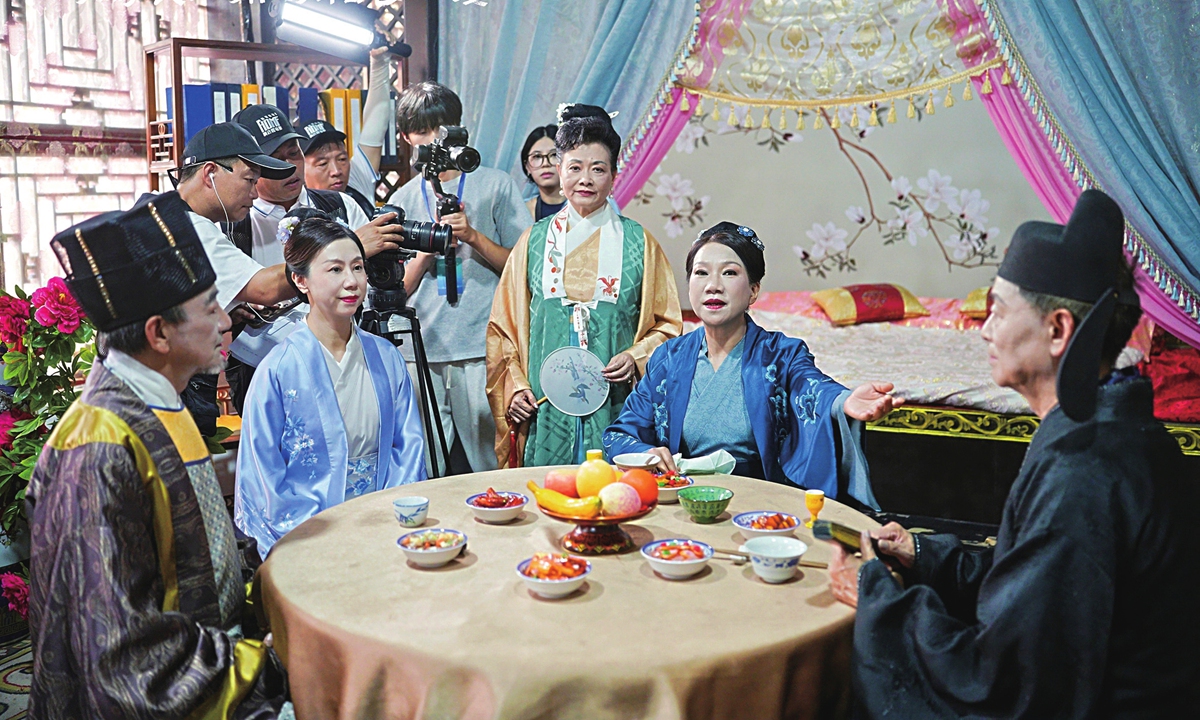
Beyond acting in Hengdian, other forms of experience-based consumption, including ancient-Chinese-style photography, senior study tours, and cultural workshops are gaining popularity among the older generations.
In June, 150 elderly participants traveled to the Ancient City of Ping Yao in North China's Shanxi Province for an immersive cultural study program. Instead of simply visiting historical sites, they combined online learning with on-site practice, conducting poetry recitations in ancient streets, studying Shanxi merchant culture at exhibition halls and creating their own works with guidance from professional art instructors, as reported by cnr.com.
Hengdian World Studios has also introduced study tour programs such as "Learning history through film and television" to better meet the diverse needs of senior visitors.
Such activities show that senior tourism is evolving from simple sightseeing into a combination of learning, participation and personal expression, Zhang said.
In fact, China's experience economy among the older generation is receiving policy support. China's Ministry of Civil Affairs, the Publicity Department of the Communist Party of China Central Committee and 10 other departments have launched the "Enjoy your silver age" campaign, focusing on areas including elderly cultural activities, creative industries and social engagement to encourage new consumption opportunities for seniors.
According to estimates from multiple institutions, China's silver economy has already approached 10 trillion yuan ($1.48 trillion) in scale and is expected to reach around 30 trillion yuan by 2035, accounting for roughly 10 percent of the country's GDP. Sectors including elderly finance, smart healthcare, senior education and tourism-based wellness are expected to become major growth areas, according to a report from people.cn.
The report pointed out that against this background, precisely catering to the needs of seniors has become a key focus. For industry observers, the next challenge is how to better understand the emotional and social needs of older consumers.
Zhang Yi noted that the future of the silver economy is not only about providing care, but also about creating products and experiences that allow seniors to pursue their interests, express themselves and build connections.
。7月28日,国际足联官宣成立全资商业子公司“国际足联前进企业”(FIFA Forward Enterprise,简称 FFE),把世界杯、女足世界杯、世俱杯等顶级赛事的转播、赞助、票务、特许经营等商业权益一股脑打包,统一运营。更刺激的是,FFE 初始估值约 200亿美元,计划向私人资本出售最多 21% 的少数股权、募资 42 亿美元,领投方是约书亚·库什纳(特朗普女婿的弟弟)旗下的 Thrive Eternal 基金,摩根大通当顾问。还给了个“最后通牒”:211个会员协会,9月19日前表决,同意每家最高拿 4000 万美元,不同意就维持原状。欧足联当场炸了。7月30日,55个成员协会一致投票,只要 FFE 提案还在,欧洲国家队就抵制一切国际足联赛事,包括男足、女足世界杯和世俱杯。声明写得火药味十足:“足球的灵魂和治理不是可交易的资产”“没有人有道德权威去出售他们仅仅作为信托持有的东西”。很多球迷第一反应:这不就是乒乓球界的 WTT 吗?确实,论“长相”,两者几乎一个模子——都是联合会成立商业子公司,集中打包商业权益 + 赛事运营。WTT 2019 年由国际乒联(ITTF)创立,2021 年起接管全部赛事商业开发;FFE 也是这个套路。甚至连“血缘”都连得上:当年帮 WTT 搭商业架构的菲利普·勒弗洛赫,正是前 FIFA 首席商务官、前欧足联市场总监。这套玩法,本就是从足球圈流出去的。但形似,神不似。核心差别只有两个字:所有权。WTT 是 ITTF 的“亲儿子”。

C | 一开始 ITTF 100% 持股,后来也只是把一笔 286 万美元的债务转成 15% 股权,ITTF 至今握着 85%。

D | 双方签了 15 年主许可协议,WTT 每年向 ITTF 交许可费、分红利;商业计划要 ITTF 执委会年审,账目审计上交,还有明确的终止条款。说白了,WTT 是联合会伸出去的“手”,绳子始终攥在自己手里,而且截至前几年还连年亏损——盘子小、风险自家担。

E | FFE 却不是“手脚”,而是“卖股份”。它要把估值 200 亿的商业化身子里 21% 的股权,换 42 亿美元现金塞进外部私募的口袋。对方不是来帮忙运营的 IMG 式服务商,而是拿着钱、天然要回报最大化的股东。FIFA 嘴上说“保留独家控制权”,但 21% 的大股东绝不会只当看客;更扎眼的是,这笔钱来自带美国政治标签的基金,过程还在密室里构思、用 deadline 逼票,谁最终获利完全不透明。这正是欧足联怒吼“出卖灵魂”的地方。所以问题来了:乒乓球能这么干,足球为什么被抵制?答案不在“结构”,而在“规模、控制与地缘”。第一,盘子天差地别。

F | WTT 那点商业价值,连年亏、奖金池才千万级;FFE 是全球最值钱的体育 IP 之一,200 亿美元估值。动心的还是背景成谜的美国资本——这天然触发“世界杯被买断”的主权焦虑。

G | 第二,谁在创造这笔钱。

H | 足球的真金白银,大头来自欧洲的俱乐部和联赛(欧冠、英超、西甲)。欧洲贡献最多价值,却被 FIFA 用 211 票“多数决”拿走统一打包出售。WTT 时代,乒乓球没有能与之抗衡的商业联赛中心,ITTF 说了算,自然没人掀桌。第三,权力结构本就对立。欧足联本身就是巨头,长期与 FIFA 明争暗斗(欧超联赛风波、世俱杯扩容全是导火索)。FFE 是压垮骆驼的最后一根稻草。

I | 乒乓球界没有第二个“欧足联”来叫板。

J | 第四,收买与分化。

K | 因凡蒂诺给小协会每家两三千万美元,把 211 家拆开;欧洲孤军抵制,但偏偏欧洲是价值与荣誉的核心,所以这份“抵制”才致命。结论:FFE 不是 WTT 的复制,而是它的激进化版本——把“集中运营”升级成了“部分私有化”。球迷反感的从来不是商业化本身(WTT 也在狂奔商业化),而是把一项运动当成可交易资产、还卖给背景成谜的外部资本。足球这场“灵魂之争”,剥开理想主义的包装,本质还是权力与利益的再分配。至于欧足联的抵制是真是假、能撑多久,9月19日之后,见分晓。看足球上咪咕视频!(罗掌柜)

L |
Current article:http://8gb.zhaoliebengkuaiwaigeqi.bond/806/tk90xv.html
Published on:02:26:27